Local Meat Supply Chain Coordination System

.. pretty much a luddite here … happy this space exist…first stab at a manifesto… will appreciate your advice

Problem to be solved: Any supply chain for beef (conception to consumption) takes a lot of time, space, equipment, infrastructure, and energy. There are more than two years of decisions/events to document, information to capture, and transactions to execute (rent, transport, feed, vet med, slaughter, age, process/pack, store, distrubute, sale, etc). The industrial supply chain is dominated by a few multinationals and it very efficiently converts resource (land, labor and animals) into money. U.S. herd numbers are low. Prices are high. Geopolitical events are disturbing. A local beef supply chain seems important. The local chain (atleast here) is more like schrapnel .. it has to be gathered and stuck together, and it can’t take much pressure. This seems like a problem.

Big Hairy Idea: The process of coordinating, improving, and expanding the local chain would benefit from a decentralized, transparent, secure, platform that enables many supply chain participants to invest in, coordinate, fulfill, and realize their own role in the creation, maintenance and operation of the chain.

Building the Body of the Beast: Think of a beast and build a part, if the part works, build more parts; if nobody’s part works, build different parts, when all the parts work build more beasts.

Building the Brain of the Beast: Even a brainless beast can use prices and quantities to make money, but this beast needs a complex nervous system to produce real value. The existing market/supply chain runs on price and quantity — dots and dashes – like morse code.

I dont know how to express this in terms of technology.

The beast should enable: (1) multiple users to input various date and connect them a specific person, animal, place, time and/or etc; (2) selectively share or not share such data: (3) aggregate or segregate data by person, animal, location, time, and/or etc. for decision making; (4) scheduling transporation, pick up, delivery, other services, etc; (5) make/document agreements re: purchase and sale of goods/services; (6) confirm performance of agreements; (7) make and recieve payments).

Building the Heart of the Beast: At the heart of the beast is Trust and Shared Values need to solve the Big-Box Dilemma.

The beast enables the supply chain participants to: (1) define their shared values; and (2) communicate credible information need be confident that each has and will act consistent with those values.

In the Big Box dilemma, consumers and farmers (as well as other supply chain participants) could: (1) operate consistent with their ethics in a local food supply chain and produce/buy food that is more valuable to everyone; or (2) they could opt for the industrial/big-box supply chain get something cheap even though it is contrary to their values. Farmer opt for the industry supply chain because he doesn’t trust that the consumer will actually pay for the more valuable product. The consumer opts for the big box store because he doesn’t trust the farmer to actually have raised the product as represented. (This is a form of the prisoners dilemma: two suspects (A and B) are arrested and interrogated separately. If they both stay silent they both serve 1 year, but if one talks the traitor goes free, silent person serves 3 years. If they confess, both serve 2 years. They both talk because they can’t commnicate and dont trust each.)

My Leg of the Beast: A platform to coordinate the supply chain for beef from 50 head of cows raised on one farm and sold in the Tulsa market. The purpose of the platform is to enable farmer, landowner, investor, and consumer to input information and be confident that the beef supple chain has been operated in accordance with their shared values.

Details: There is a farmer that raises beef for the local market. He does not have enough beef to meet the demand. He has the opportunity to rent from a landowner who values local food. There is an investor who wants to buy cattle for the farmer to raise beef for the local market. They will agree that the farmer will own 1/2 of the beef and the landowner/investor will own 1/2 of the beef.

The farmer and the landower/investor want a tool for so that: (1) they can input and share detailed information on 50 individual cows; (2) farmer, landowner, investor and customers can access the info on each or all of the 50 cows and their calves; (3) the information will be trustworthy due to verification measures; (4) the landowner/investor will have access to information regarding the status of their cows and land: (5) the farmer, landowner/investor and customers can express their values related to the land animal and food; (5) customers, landower/investor will be able to conclude if the cattle are being raised in accordance with the values they share; (6) butcher will be able to input performance data such as weights and amounts of beef/cut produce by each animal, (8) the data butcher will be convertied into inventory info for butcher, farmer, landowner, customers; (9) customers will be able to purchase beef on the platform.

Questions:

Does this resonate?

What is out there for this?

What question do I need to answer?

What do I need to learn?

Who do I need to talk to?

2 Likes

Hey @Harlan I like your description of the issue

I talked to you before, and I want to make sure the ideas are coming through here. Can you specifically say why the landowner and farmer can’t just split the sales (50/50) using traditional wholesale channels or through tools like barn 2 door, OFN, Rooted Solutions, etc. for direct to consumer sales?

Are you trying to solve the lack of traceability, or pre-selling (to avoid a loan), … or are there other problems you’re solving or benefits (time/money/effort/etc) savings involved?

Clarifying those things would help explain the idea I think.

1 Like

Question: Can you specifically say why the landowner and farmer can’t just split the sales (50/50) using traditional wholesale channels or through tools like barn 2 door, OFN, Rooted Solutions, etc. for direct to consumer sales?

Are you trying to solve the lack of traceability, or pre-selling (to avoid a loan), … or are there other problems you’re solving or benefits (time/money/effort/etc) savings involved?

Reply: Like the consumer and the farmer, the landowner, investor and farmer are also caught in their own version of the prisoners delimma. The investor and the landowner are tempted to demand more from the farmer, which pressues the farmer exploit the land and the animals. With communication and trust, I hypothesize, the landowner would opt for soild health instead of greater rents, the investor would opt for health of his animals instead of greater return. I have not written, or even thought, about this enough to summarized it effectively. I’m not familar enough with those platforms to say more about them

Hmmm…

Do you think the problem you’re trying to solve is unique to farms which are experiencing excess demand from consumers and landowners who could help them increase supply? That feels like the trickiest bit (3 players building trust / sharing the cost/benefits), compared to the traditional problem of farmers and consumers.

Is that fair?

Thank you for continuing to pursue this. I have not communicated my idea very effectively. I’m comfortable and patient with the process of fixing that and I appreciate your help.

I don’t think problem I see is unique to my circumstances. The problem – a thin supply chain and lack of a coordination system – exists independent from our current circumstances.

As to our current circumstance, as I see it, you’ve accurately described two aspects: (1) excess demand from consumers, and (2) cooperative landowner/investors. I don’t think this is unusual. I presume that most local food businesses begin because there is unmet demand, a cooperating landowner and a like-minded investor. My perception is that most start-ups fail due to supply chain problems, and because people give up before the problems are solved. Using the “prisoners dilemma” analogy, giving up is couched as “betrayal”: the consumer won’t pay a price that covers the cost; the producer cuts corners on growing methods to reduce costs; the landowner demands rent that revenue can’t cover, the investor withdraws if profit requirements aren’t met.

Thus, my premise is that in all local food chains there is a need for technology to facilitate the exchange of more supply information and create more trust needed for participants to solve the problems.

Of course the agri-food industry has uses the most advanced IT in this way to serves it own purposes. I’d like a advanced IT to use it our small piece of the supply chain (local beef in Oklahoma) for the purposes of the participants in the supply chain.

I feel certain someone has done this in another context. I’m in such of someone to do it in ours.

Thanks, yeah that helps.

I think the addition of the landowner, and that decision about expanding capital to cover more consumers, feels interesting and unique.

I personally would draw a circle around this:

Tech that helps clarify the opportunity and ask between those three parties (producer, investor / landowner and consumer(s)) around a specific long-term capital investment decision (adding 50 head). This feels potentially unique and valuable and potentially unaddressed.

Re. how useful this is beyond your use case - I think there are comparable things in other areas of ag (row crop, veg, etc.) when product expansion is on the table. That said, animals are unique in the size and term of investment and return… so the problem feels more pressing here, but I’m guessing also exists elsewhere.

What do others think?

What are other related, adjacent, or maybe exact solutions to this problem (software, process or other)?

… what other questions should we be asking, thoughts should we be having?

@sudokita @julietnpn @themj @ErikaFosterSoils @kanedan29 @ElizabethVaughan @GOATforMikeD

Just my 2 cents here- I am huge on solving matching problems and logistical problems. I think getting goods to the people who are looking for them will help lower food waste in a big way!

But, to me, The biggest bottleneck in the system is slaughterhouses. As a small producer, it is so hard to even get a date to process and often the cuts are not what you actually asked for. Also, many slaughterhouses opt not to be usda certified (so you cannot resell the meat legally, though people do have some wiggle room, but retail is off the table) because the regulations are a lot to navigate and expensive. These guys book up as non usda so why do the paperwork.

The other real hurdle as a producer is wasted cuts. So if you are producing lamb, you will sell out of chops right away… but good luck selling neck or organs. Maybe there is a way to solve this problem as well through matching ie a supplement company buys all the livers and hearts, a dog food company buys other organs through the portal.

There are farm link programs which help people find land to farm, often because retiring farmers want someone to take over, but these dont have any component that makes the supply chain transparent.

I think the landowner piece will be complicated only because contracts will have to be clear… you know like what happens if the cows get out and do damage? These questions should be answered up front, maybe through templates, because if there is conflict it can get hairy quickly.

Also, a big hurdle is that many producers dont have a clear idea of how much it takes to produce their product. While this is easier with cattle than with diversified veggies, farmers usually need some instruction on how to properly keep records so they can be sure they understand gross and net.

This is an exciting idea, these are just pieces to think about!

4 Likes

I don’t have an answer, but maybe something adjacent for some tickler ideas that might become more of an answer. :slight_smile:

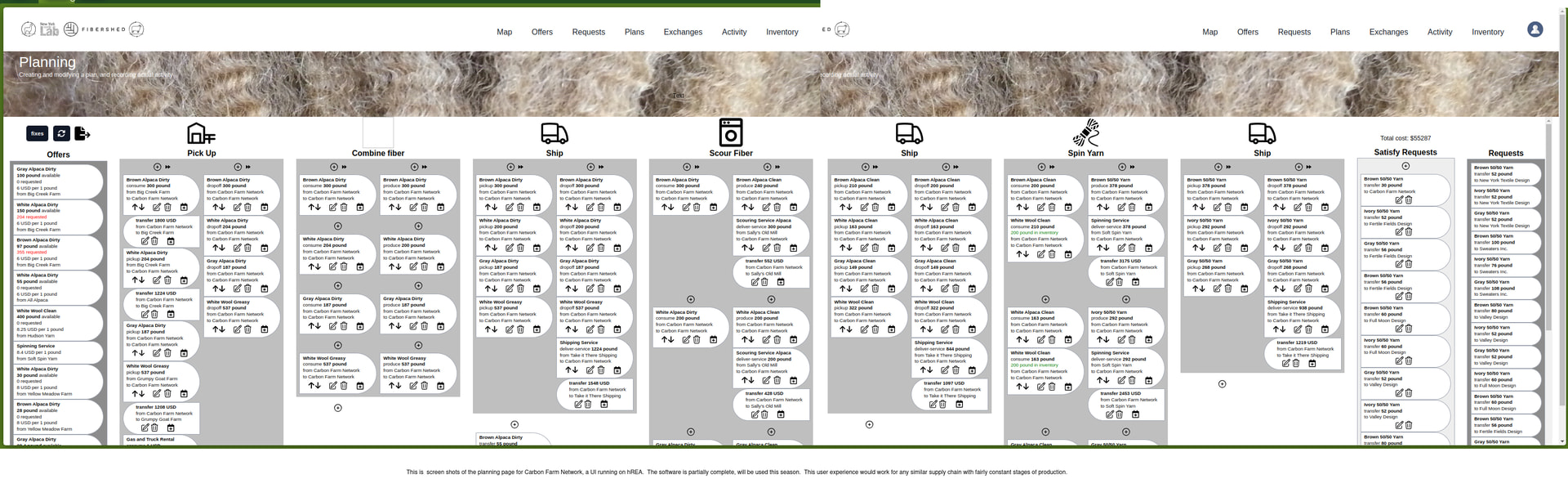
This is a supply chain app under development for local/regional supply chains with sequential repeated stages of production, in this case a textile supply chain network from farm to yarn, called Carbon Farm Network, in NY Hudson Valley. It has a page used for planning the season (but could be any size plan), then recording what actually happened. So beef people could work together to make it all add up for everyone, or understand it won’t, for an added-supply scenario. Or people could maybe do their own what-if’s. It assumes trust, but also might help build trust.

Here’s a (test data, some things missing) screen shot to get the idea.

The data structure of the app (from Valueflows) also supports track/trace, so you can also get everything that actually went into the final product if people along the chain enter it. Can be used for customer info and trust.

It might be possible for a one-off situation to build a spreadsheet with approximately this data structure that people can play with (if you’re a spreadsheet guru, which I’m not, but I would help).

If you want to see it more in motion, here’s a video demo of the planning (28 minutes), the page in the image shows up around 16 minutes.

2 Likes

You obviously know this supply chain! We only have this opportunity because some of the issue you mentioned don’t hit this project so hard 1. The producer has a family relationship to the slaughter facility; 2. We have a free lawyer to work on contracts; and 3. The producer has several years of experience with getting a handle on his cost. I don’t think we would have the resources to work this technology if we were facing those issues as well. We hope that this technology will be a tool that will help address those issue when they arise

Thank you I’ll follow up

Hmmm actually Lynn… this does feels ValueFlows relevant.

It’s a question of transparency → clarity → trust → investment → contractual clarity. It feels very ValueFlowsy.

What you showed helps with transparency and clarity… it would be interesting to walk through it and see how you can then get to the trust + investment + contractual clarity.

Maybe Harlan the other parts are the parts you already have covered?

I’m not sure if I see a clear problem statement here? I’d be curious to hear the farmer’s perspective in this arrangement and if there is actual mistrust from the consumer. Why does the farmer want this detailed information? How does it impact his decision making? Why don’t the partners trust each other? Yes, international trade and USDA slaughterhouses are a huge issue that need to be addressed for our local meat producers. Until our federal policies & barriers are addressed, I would argue that a lot of assumptions are being made in this initial presentation regarding coordination. Local ranches are figuring out creative direct-to-consumer markets, and online platforms like https://www.grazecart.com/ got bought out. There is a huge demand for local meat with ranches selling out every year (see 5 Marys Ranch). People purchase cow shares all the time. Marketing goes a long way in building consumer trust! So are transparency issues actually a marketing issue? And are the other items separate issues that need to be solved through business negotiation and mediation?

Two major challenges for all producers are also access to land and capital. It sounds like this rancher has offers to help with those items but I question if the other two players getting more involved than they need to be? What concerns can’t be met with support from legal documents and clear boundaries? An additional layer to any farm business practice needs a very clear return on investment.

Alternatively, a cooperative business structure and ownership can help address all the important pieces to build a solid foundation for them to work well together while profiting, as they have for other farm producers, but that’s like getting married to multiple people.

2 Likes

These are the compelling pieces to me also Elizabeth. @Harlan I think you’re hearing that the data tracking / transparency is a well worn path with questionable value, much complexity and pitfalls and might not be the place to start per se… though, as always, feel free to push back!

@ElizabethVaughan what if the problem statement is “we want to improve producers and landowners/local investors ability to fill persistent excess demand for meat. We do this by: helping them find each other, connecting faster, lowering the barriers to connecting, establishing standard and fair relationships, identifying unique legal mechanisms to share risk and reward, lowering the cost of collaboration, etc.” Does this sound better / more compelling?

@Harlan Is this too disconnected from your key concern, or does this feel helpful?

1 Like

re-reading some of Harlan’s post, I come away with an understanding of a problem I face a lot. When considering whether to add a new crop or package current crops in a different way, It is a chicken and egg scenario regarding demand. Ie, I can ask people “would you buy golden beets?” and most people will not respond but some will say yes. I then plant them and find there is not a market at the price I need to charge once labor etc has been accounted for. Or, I have a whole bunch of nice beets and I send out samples and generate the market.

Ultimately, I don’t think it has ever been clear to me ahead of time if I can sell what I grow. I try my best to secure standing orders and commitments but I have also had folks tell me they would buy all of x crop only to have them flake out. When certain crops take months to come to maturity this is obviously not ideal. The CSA model tries to address this but people do not want to be locked in to weekly produce boxes.

@ElizabethVaughan makes a fair point that if you do a killer job building a waiting list and marketing, maybe the problem is solved. I do really wonder how to get people to tell me early what they want and at what price, because for some reason this seems very difficult. I sometimes want to approach it like a conversation, because while we don’t have crazy margins, there is wiggle room and if coming to a lower price helps us sell more, there is a sweet spot. My mind almost goes to prediction markets that are so much better at seeing future outcomes than any one individual… Let’s bet on the price of bagged arugala this summer! I think a tool that would help farmers understand the curve of price vs sales and what the market is willing to bear would be great, though as a small farmer I have a unique value proposition that I still do have to communicate effectively to increase the perceived value of my goods ie we grow ecologically, we give back to our local community by donating unsold produce etc

Lastly, @Harlan, I would push back on the idea that farmers start producing because there is unmet demand. A lot of small farmers start because they love the actual raising of animals. Other people try a whole host of ideas before falling into something they produce well or grows well on their land. I personally shy away from animals not because I think there is less demand than veg, but because it is so hard to find someone to farm sit if you even want to take a weekend off.

There is a huge unmet demand for fresh strawberries in my area, but I would never grow them because conventional growing requires so much spraying and I am not sure people would pay for organic. There is a huge demand for fruit in general but the investment of years for trees to mature is not something I am comfortable with, especially since I am not confident in my skills as an orchardist. However, we are considering putting in some primocane blackberries this fall but we would have to really be thoughtful about if the labor to pick makes that a worthwhile venture- so we are back to the same spot- will the market bear the cost??

1 Like

I appreciate you struggling with these questions. In this part of the discussion, it seems to me, we are addressing the nature of the problems that the people in the local food supply chain actually face. Is it this? Is it that? Or is it something else? All are good discussions and questions. Of course, I don’t have the answers — or even the right questions.

But I envision a tool that provides more information to more supply chain participants so their decisions — and the answers to our questions — can be based on more information.

My view is that multinationals use information tools to manage supply chains to serve their interest. My premise is that many alternative supply chains would have a superior results (i.e. fewer externalities = more effcient, greater security, and safety) if more people in the supply chain had more access to more information.

long time ago I grew tired of trying to answer local food question without access to vital information. What brought me to GOAT is my search for someone with skills needed to bring the power of information technology to bear on the questions (no matter what the question are)? I’ve quizzed AI about this and it tells me I need the services of “a full stack developer with strong Python development skills for the backend, and Flask framework, expertise in MySQL for database design and management, and orofecinciy for Javascript for developing responsvie mobile and web interfaces.”

I have only vague notion of what that means, but it sounds convincing, and it sounds like someone may have already done … so far I haven’t found them.

This sounds promising, I’d like to learn more.

Thank you for all your comments. This has been helpful. I come away with a few thoughts.

  1. Does what I’m looking for exist? I looked into all that were referenced and only the system LynnFoster referenced seems to be applicable: it covers the whole supply chain, it gives acces to various supply chain participants, its flexible and expandible.
  2. Does the idea resonate? doesn’t seem to. Nonetheless I’m willing to take the risk of getting to proof of concept.
  3. The learning curve is steep – but aren’t they all.
2 Likes

Good conversation! Thanks everyone for contributing.

I think my two cents after reading through is @Harlan you believe that more supply chain information will help all actors (full stop) because that proves out in larger international markets. The particular details are still unclear (pointed out by others)

@lynnfoster I think you’re in the best position to think about what a ‘view’ into a local supply chain would look like (seems like that’s a base feature of Valueflows). It seems Harlan that to test your hypothesis in any form, you have to first map and make visible the local supply chain (then you can show it, share it, make offers on it, simplify it, etc. whatever the ultimate actions are).

Perhaps in that first conversation, if you can find one specific utility of this first step (like… to support conversations around expansion or investment), that’s enough specification to attempt to make a simple prototype.

Not sure if that works or is compelling, but it’s a thought :slight_smile:

3 Likes

An update on this thread. @Harlan and another colleague of his are in ongoing discussions with Valueflows and the GrowGood team about doing a supply chain piece that will connect with GrowGood and take it from farm to cuts of meat output from the abattoir, including visibility of the stakeholders into the farm and supply chain as the meat is raised and processed. They don’t need OFN retail/hub yet because their current customers are internal to the network, but I think that could be in their future, as they do think about growing the meat and other food ecosystem in their area. I personally look forward to that, as it could be a concrete project with Valueflows - DFC interops.

1 Like